Futurewise’s Founding History
as Steward of the Growth Management Act
When the Growth Management Act (GMA) passed in 1990, Washington became one of the first states in the country with a statewide land-use policy.
This landmark policy framework was possible thanks to dedicated champions both in the legislature and in the citizen-led advocacy groups that would go on to found Futurewise.
For the last 35 years, Futurewise has been your steward of the GMA, and this is the story of how we got here.
Key Moments
Key Moments
PHASE I: Washington’s Population Booms, Planning Policy Isn’t Keeping Up
1980’s
Communities feel the squeeze of rapid growth
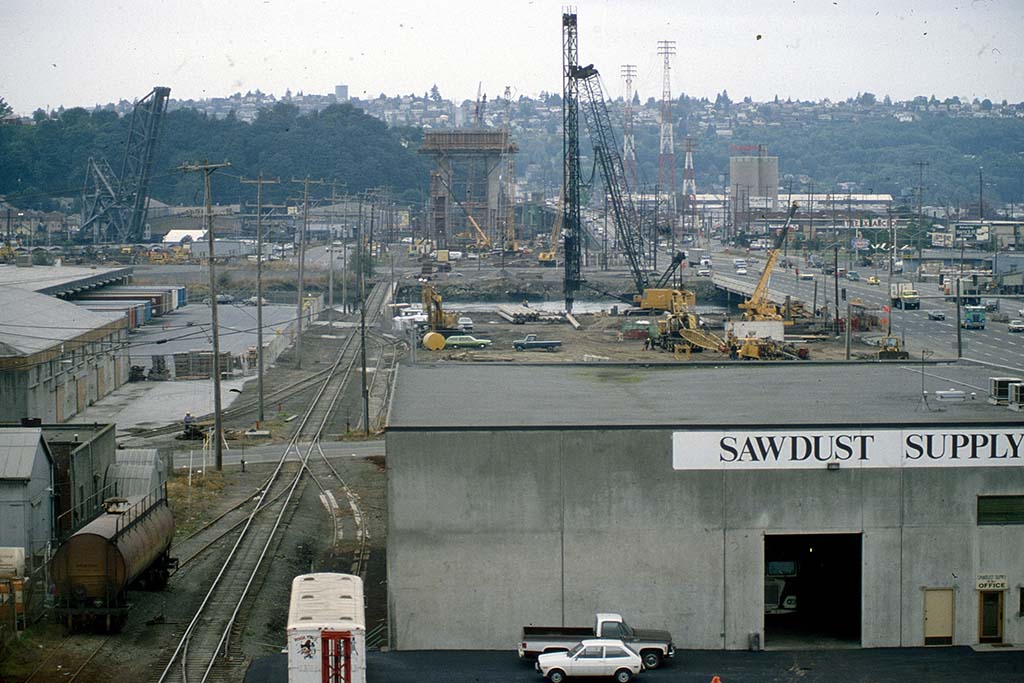
Until the 1980’s, Seattle was a smaller, some said sleepy, city. But then came changes brought by rising population growth, and especially the dot-com boom. People were noticing changes to tree canopy and open spaces, and road congestion – everyone noticed the traffic. Logging activity was also picking up, which was changing forest landscapes especially in eastern King County and eastern parts of the state.
Wanting to protect forest and farmlands from unplanned, uncoordinated growth, citizen groups formed to advocate for updates to our local and state land use laws.
Many of these community organizers and leaders would go on to found the precursor organization to Futurewise – 1,000 Friends of Washington.
1985-1988
State lawmakers explore growth management policy

Elected leaders were finding existing land use laws ill-equipped to address modern challenges their communities were facing. A statewide planning framework was needed to support local governments and create consistency across the state.
State Representative Joe King, a key architect of the GMA, remembers clearly the moment he realized that unplanned growth was becoming a problem that Washington needed to address. Leaving an event with his staffer, Tom Campbell, and driving on I-405:
“I was stuck in traffic and you had five hundred new apartments. I said, ‘I wonder who’s planning that? Who’s coordinating some of that?’ And the answer was ‘no one,’ as I looked into it. So we worked on the legislation.”
The State Legislature introduced a first draft of a growth management bill in the 1988 session but nothing passed that year.
1988
Learning from others, building momentum around growth management
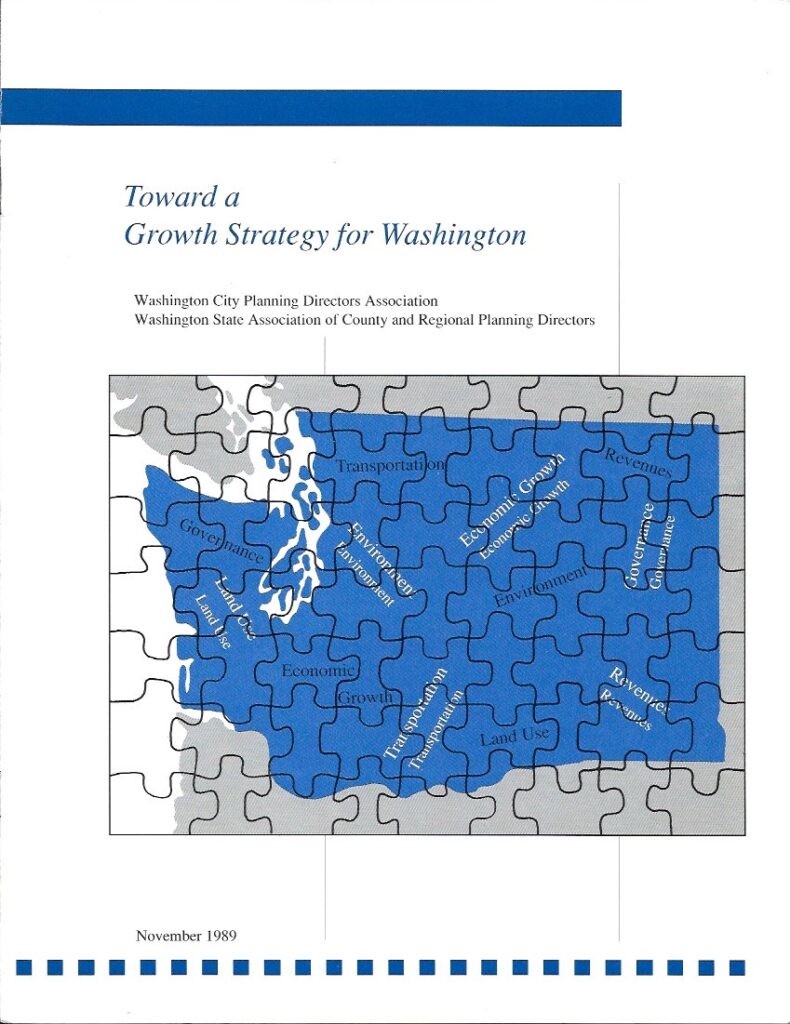
State lawmakers and staff tapped regional planning experts across the state, and looked to the only two other states who had already passed a statewide planning framework – Oregon and Florida – to see what they’d done.
Image: scanned copy of the original report from the records of former Futurewise Board member and Commission member, Mary McCumber
August 31, 1989
Growth Strategies Commission is created
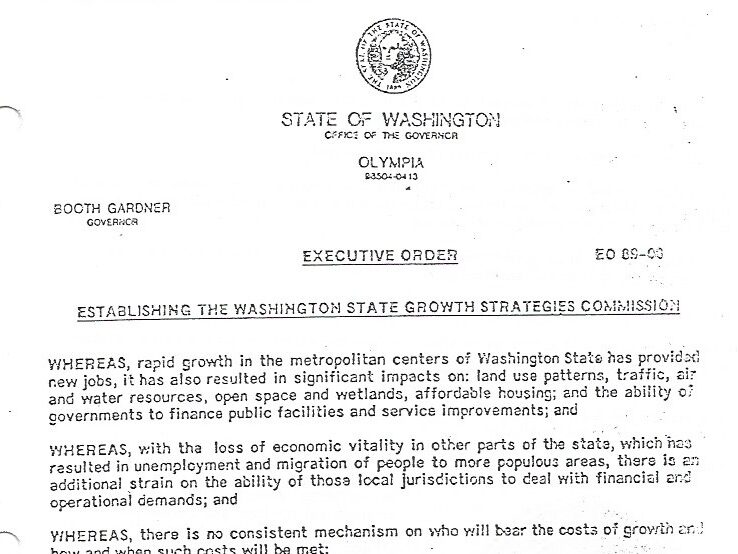
Governor Booth signed Executive Order 89-08, establishing the Growth Strategies Commission for Washington. Comprised of 13 citizens and 4 legislators from across the state, the Commission was tasked with recommending policy planning frameworks for transportation, housing, environment, and land use to the Governor and Legislature.
Image: scanned copy of the original document from the records of fmr. Futurewise Board member and Commission member, Mary McCumber
November 7, 1989
Election results show public distress over rapid growth
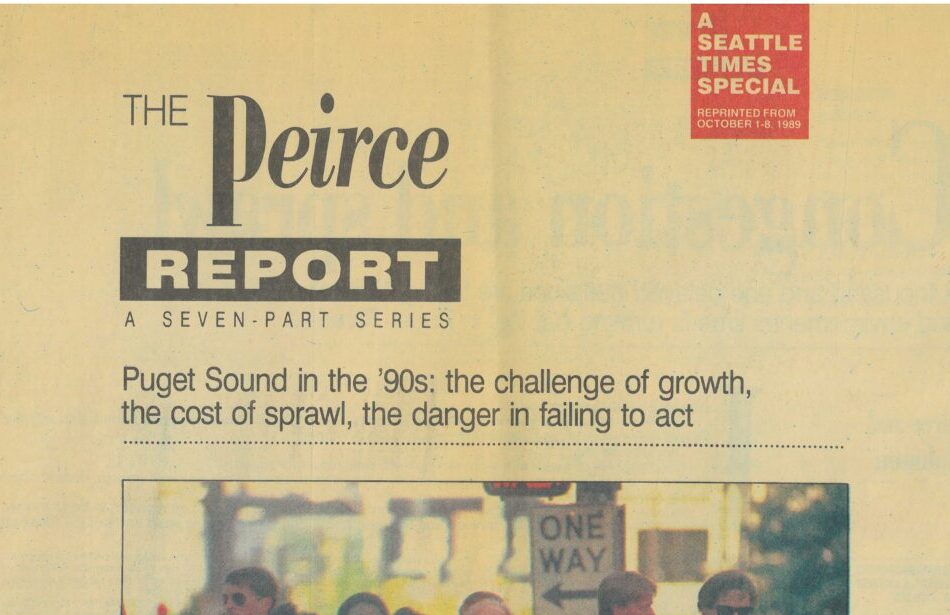
The tensions over uncoordinated growth, sprawl, and environmental impact had been building and came to a head at the ballot box. Candidates running on platforms that proposed reining in unplanned development and strengthening environmental protections beat 3 county-level incumbents in King and Snohomish.
Community organizers took this momentum from the election to the legislature to lobby for growth management legislation, not just at the municipal level, but statewide. A number of these community leaders would go on to become the founding board members of 1,000 Friends of Washington – now Futurewise.
These election outcomes further resolved lawmakers to make statewide land use a top priority in the upcoming 1990 legislative session.
Image: October 1989 Seattle Times cover of a special series on growth management needs across the state.
PHASE II: The GMA’s Path in the Legislature
1990 State Legislative Session
drafting of a statewide growth management policy begins
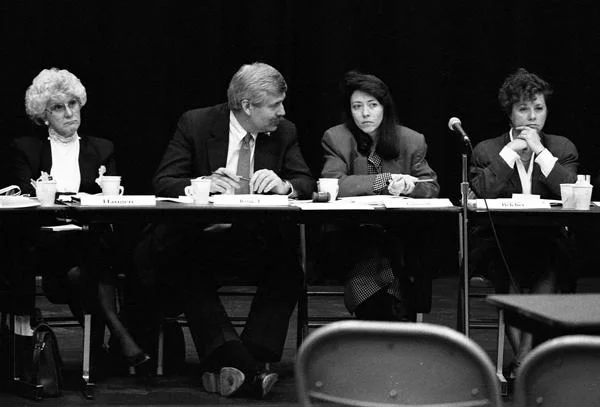
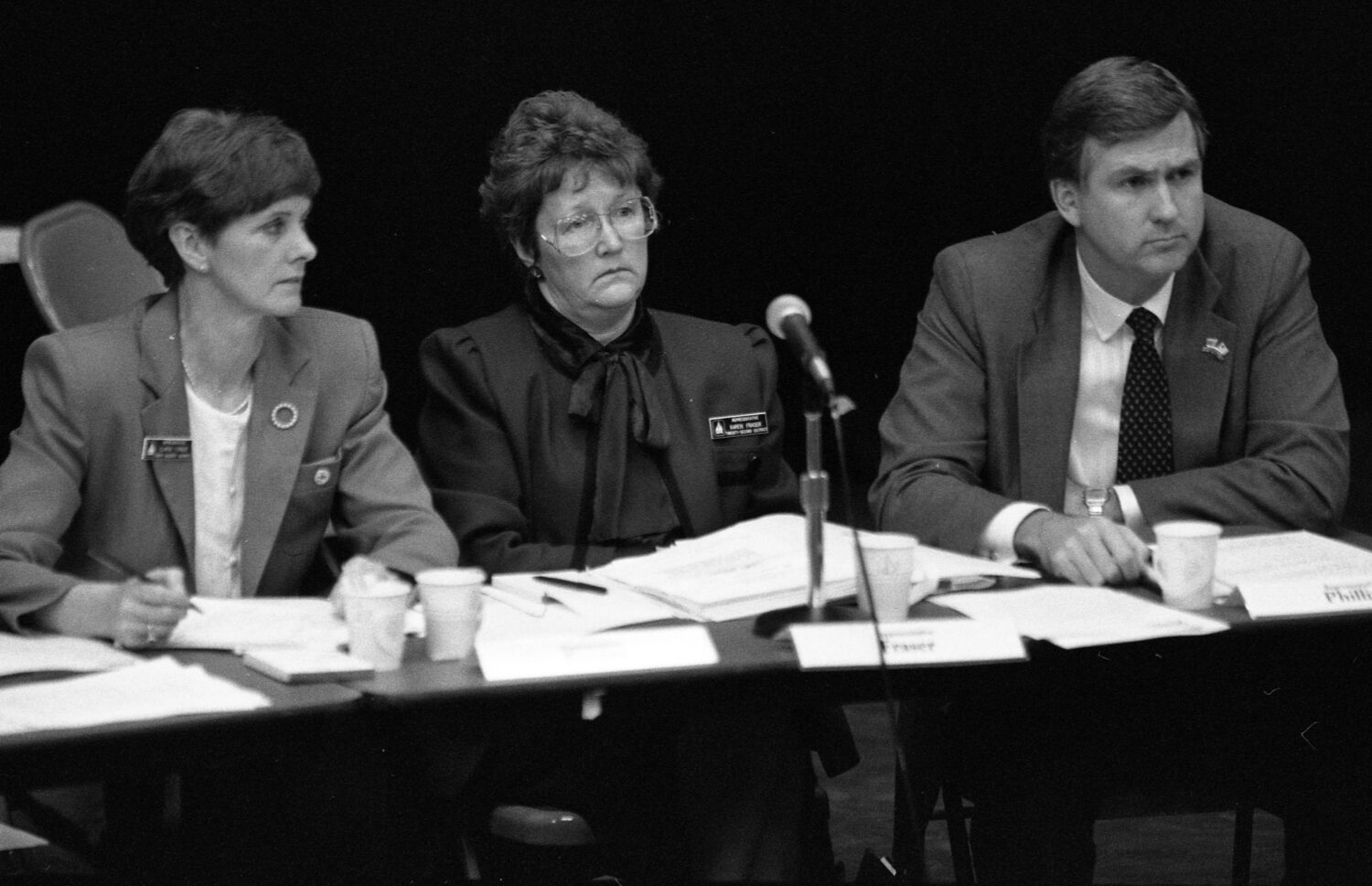
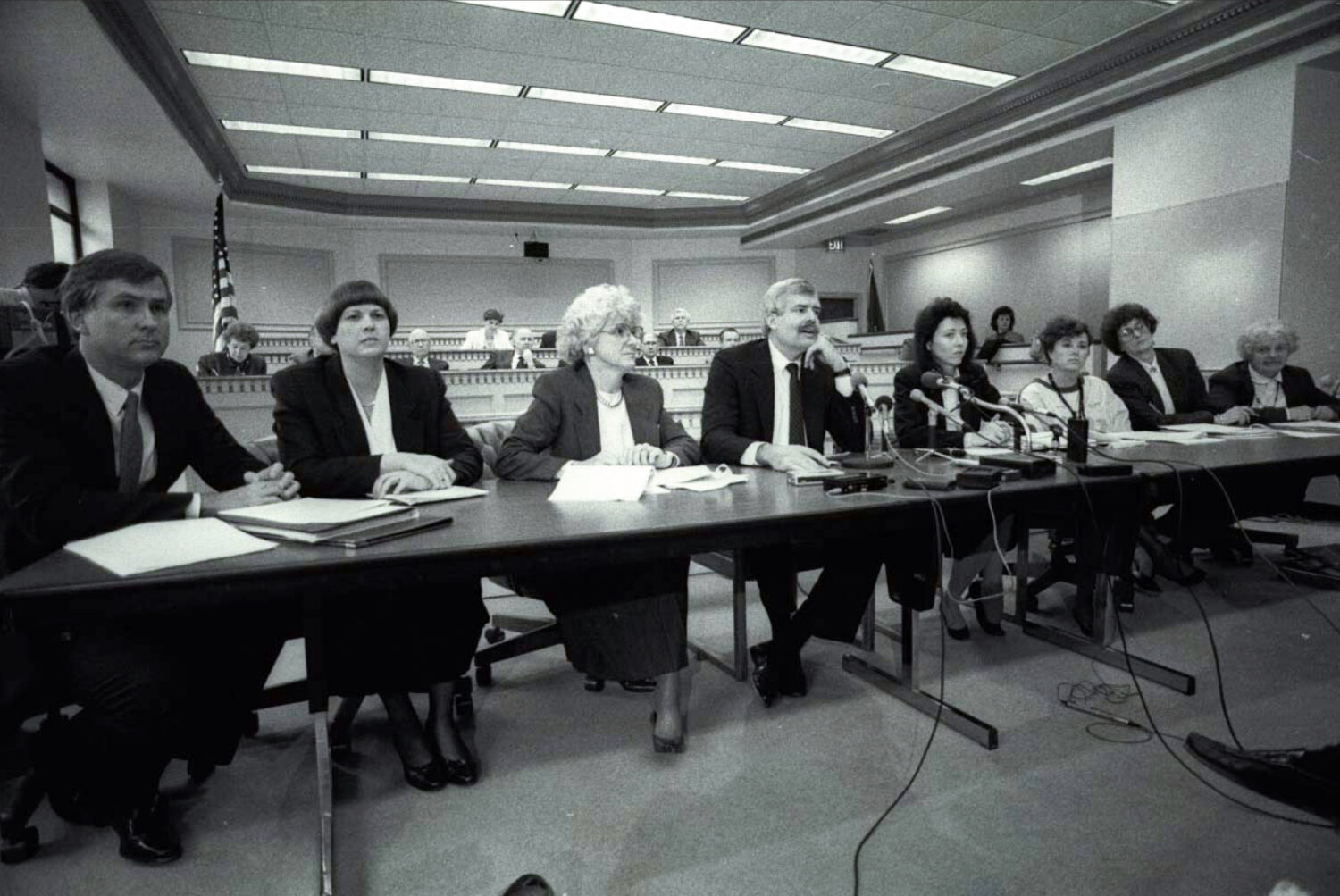
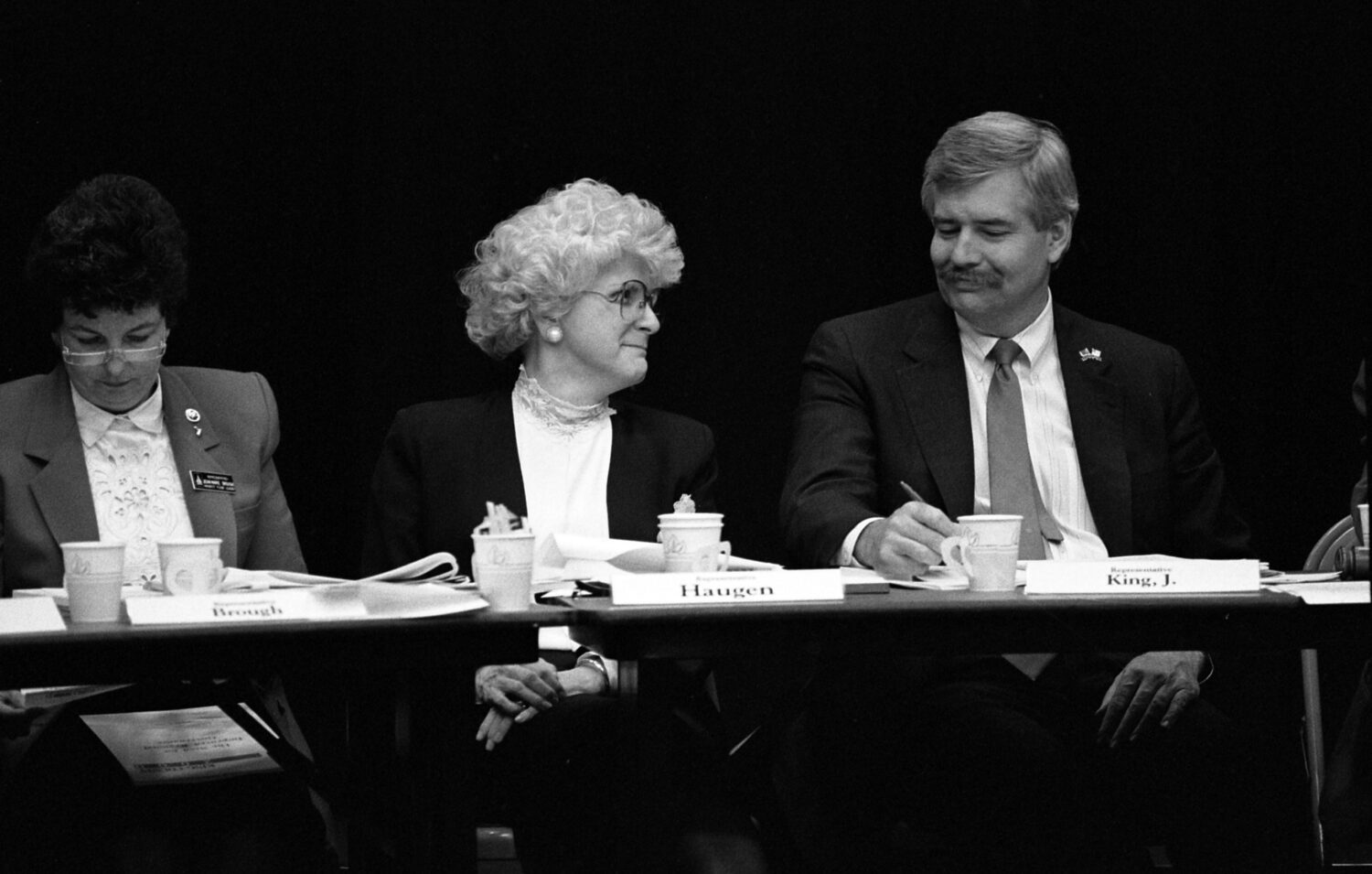
Inside the legislature, House Speaker Joe King made growth management his top priority, coordinating with chairs of the relevant House Committees like natural resources, housing, local government, etc.
The State Archives describes this history-making coalition: “A year after that movie [Steel Magnolia] was released, six female state representatives in Olympia were dubbed the “Steel Magnolias” for their grit and cooperative style that produced a landmark piece of legislation in 1990.”
The six members of the Steel Magnolias were:
Jennifer Belcher, Chair of the House Natural Resources and Parks Committee;
Maria Cantwell, Chair of House Trade and Economic Development Committee;
Busse Nutley, Chair of the House Housing Committee;
Mary Margaret Haugen, Chair of the House Local Government Committee;
Ruth Fisher, Chair of the House Transportation Committee; and
Nancy Rust, Chair of the House Environmental Affairs Committee
(Images courtesy of House of Representatives, Photo Services, Washington State Archives)
April 1, 1990
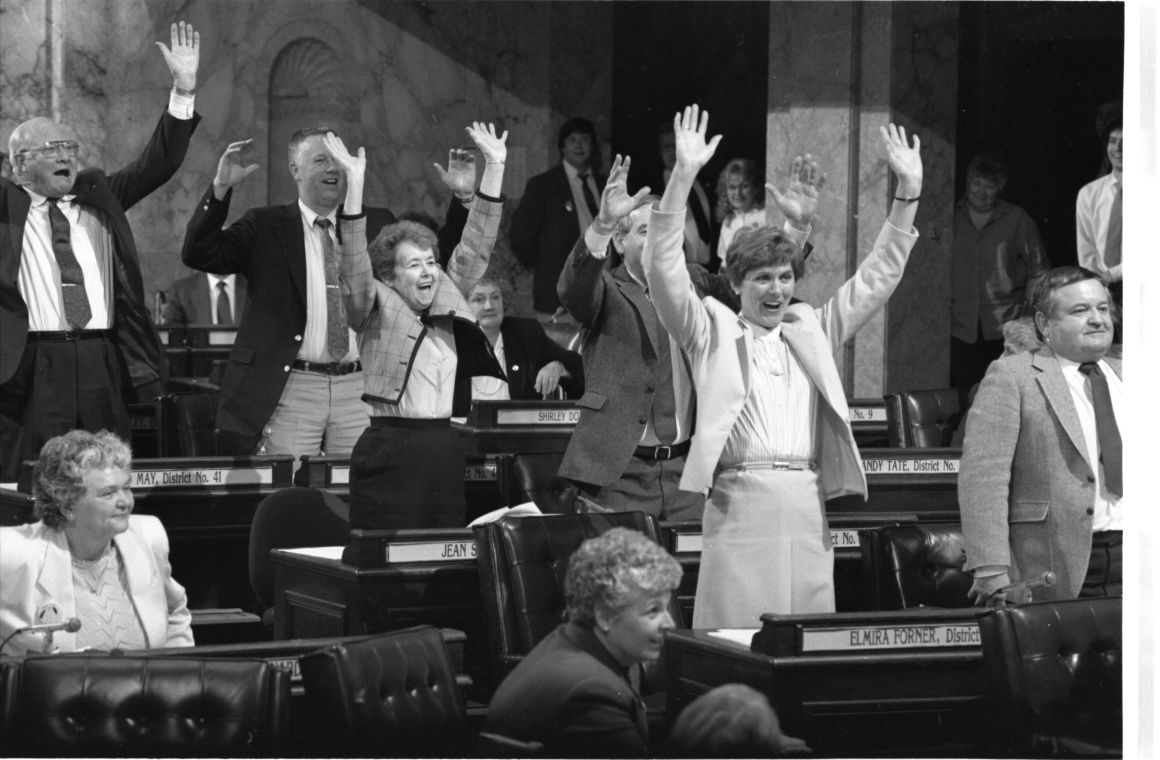
The Growth Management Act Passes!
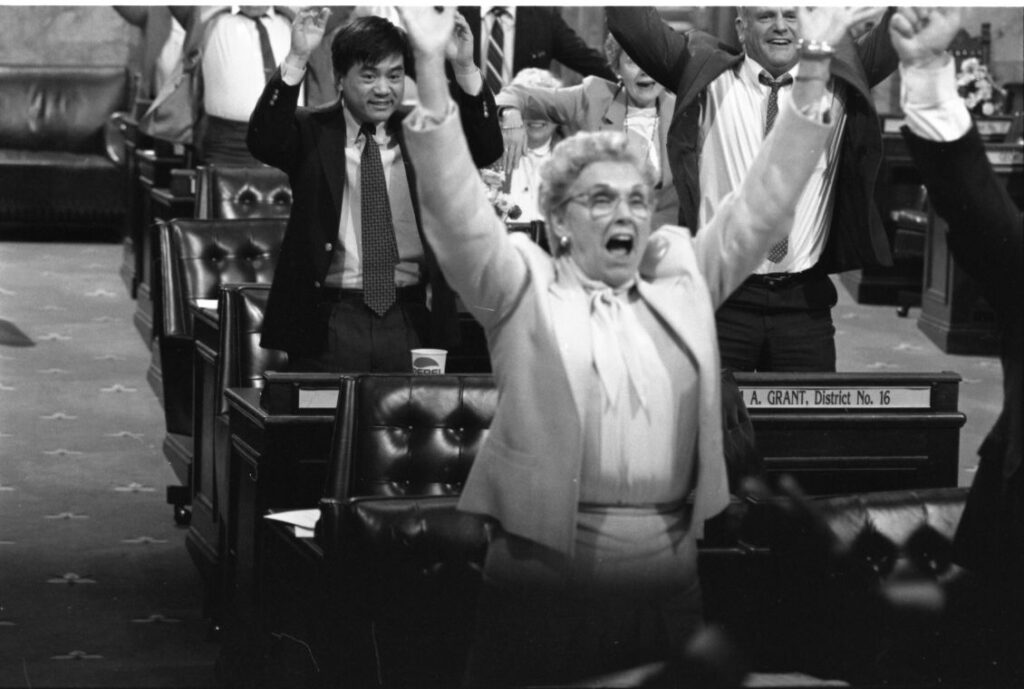
Regular session ended before any growth management legislation was passed, so Governor Booth called for a special session. The remarkable dedication of these legislative champions paid off, and HB 2929 was passed on the final day of the special session.
A foundational, but incomplete win: While the bill that ultimately passed created a critical framework, legislators recognized that it was only a first step. The policy as passed did not contain an enforcement mechanism, nor did it empower any agency to implement consequences for noncompliance – topics that would still need to be addressed in future sessions.
(Courtesy of House of Representatives, Photo Services, Washington State Archives)
April 24, 1990
Governor Booth Gardner signs HB 2929 into law
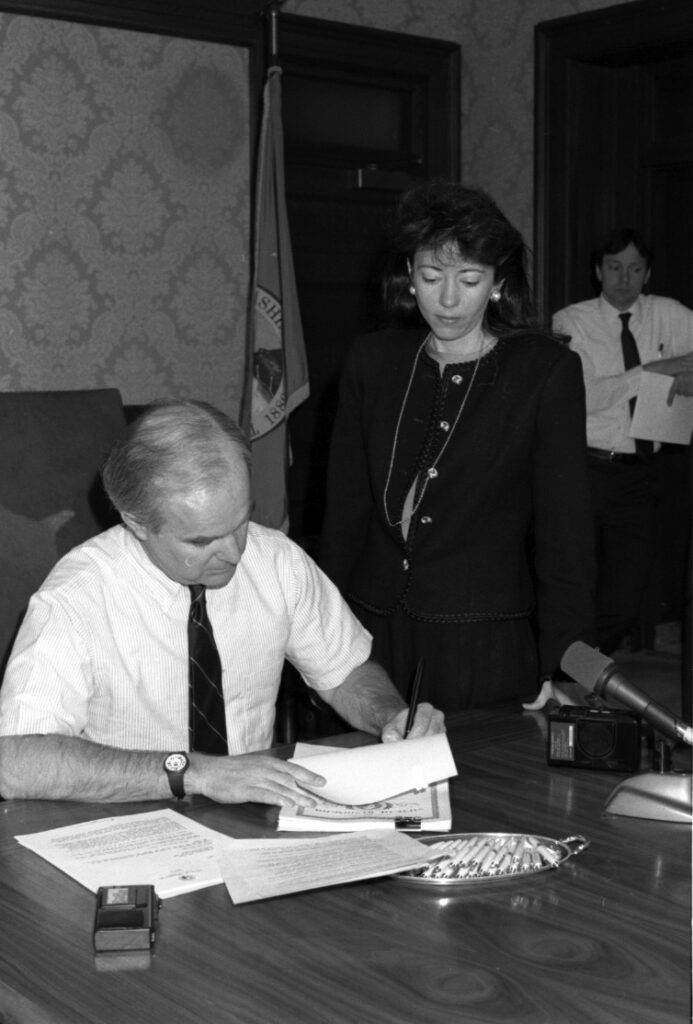
From the original legislation:
“The legislature finds that uncoordinated and unplanned growth, together with a lack of common goals … pose a threat to the environment, sustainable economic development, and the health, safety, and high quality of life enjoyed by residents of this state. It is in the public interest that citizens, communities, local governments, and the private sector cooperate and coordinate with one another in comprehensive land use planning.”
Image: Governor Gardner signing HB2929 on April 24, 1990. Representative Maria Cantwell is next to him. The images are from: House of Representatives, Photo Services, Washington State Archives.
PHASE III: Implementation begins, and the GMA is challenged on the ballot
July 1, 1990
From Law to Policy: Implementing the GMA

Passing the GMA was only the first hurdle – now it needed to be implemented. Housed in the Department of Commerce, a small but mighty team built out regulations and guidelines, prioritizing collaboration with municipalities. Through hands-on outreach and flexible state grants, they helped local governments plan effectively and built the trust that has contributed to the GMA’s lasting success.
Implementation Case Study: Olympia City Council
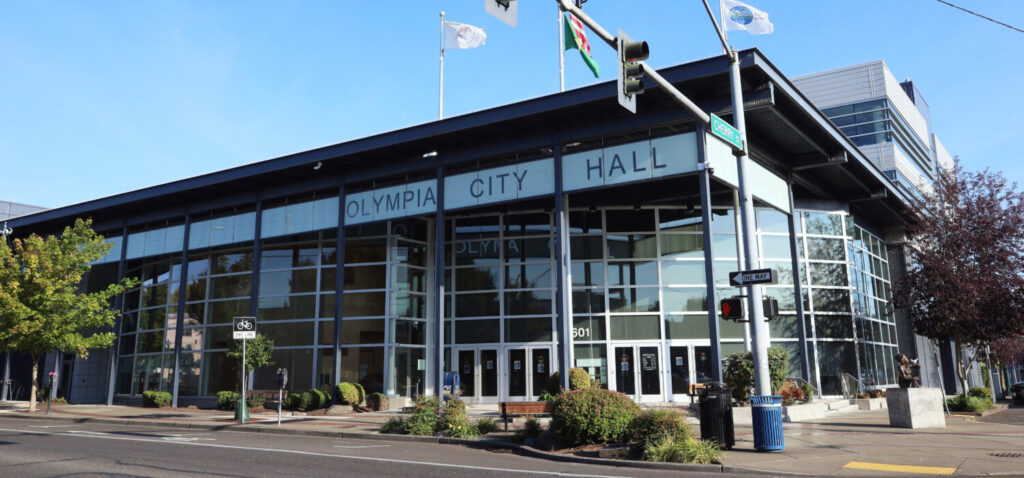
After HB 2929 passed, municipalities across the state had to figure out what this new law meant for them. Olympia was one of the first to undergo this new 20-year long-range planning process.
Then-Councilwoman Nina Carter recounts the Fall planning retreat for City Council, where they literally drew the future of what they wanted for Olympia – with crayons and butcher paper.
Photo credit: By OceanLoop – Own work, CC BY-SA 4.0, https://commons.wikimedia.org/w/index.php?curid=172138044
September 25, 1990
Growth Strategies Commission sends their recommendations to the legislature
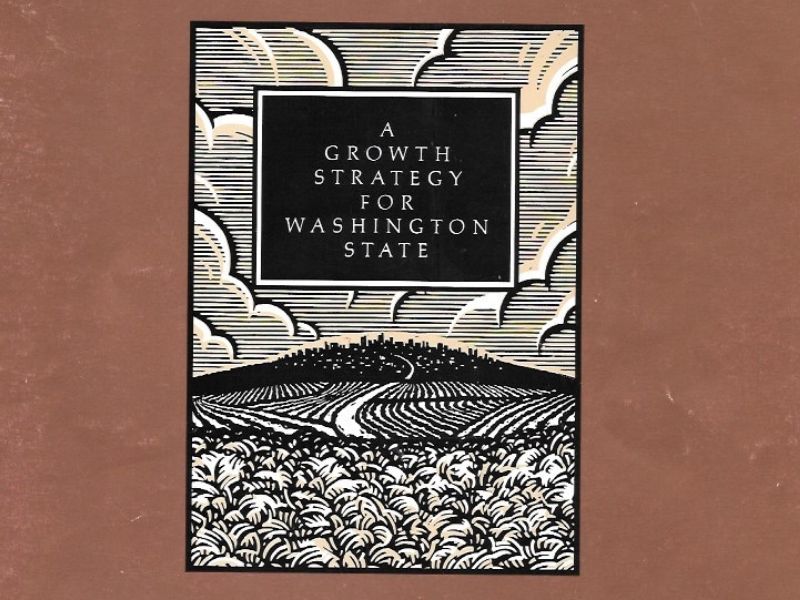
The Growth Strategies Commission presents its final report to the Governor. The report included recommendations to expand who must plan under the law and expand planning requirements, as well as recommendations for mechanisms to ensure compliance.
From Commission Chair Dick Ford:
“The Commission is developing a set of broad policies to address many growth concerns, including: the environment, the economy, agriculture, urban design, transportation, and state and local governance of growth management.”
Image: scanned copy of the original report from the records of former Futurewise Board member and Commission member, Mary McCumber
September 28, 1990
A promise of future action: The Four-Corners letter
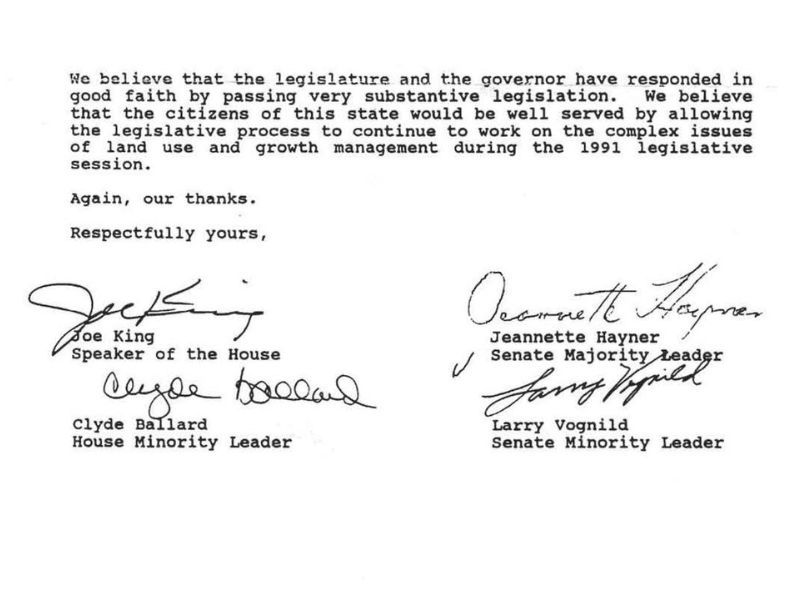
In the weeks leading up to the election, legislative leaders convened to address advocates’ concerns about the GMA, and illustrate that they were committed to policy action to address those concerns.
The result is what became known as the Four Corners Letter—signed by House Speaker Joe King, Senate Majority Leader Jeannette Hayner, House Minority Leader Clyde Ballard, and Senate Minority Leader Larry Vognild—pledging to address the GMA’s shortcomings in the next legislative session.
This letter is still regarded as one of the most pivotal and influential moments in the creation of the GMA
October 10, 1990
Community momentum turns into 1,000 Friends of Washington!
Advocates who had led the public push for the GMA since the beginning realized that, even with a strong statewide policy, there was still an important role for community advocates.
This group of land use attorneys, county and city planning officials, environmental advocates, and others turned their prior organizing efforts into a citizen watchdog group for GMA compliance and implementation.
Initially founded as 1,000 Friends of Washington, with a name change in 2005, we’ve been working alongside communities and lawmakers to support the GMA ever since!
November 6, 1990 – Election Day
GMA survives the ballot challenge, advocates vow to hold the Legislature to their promise
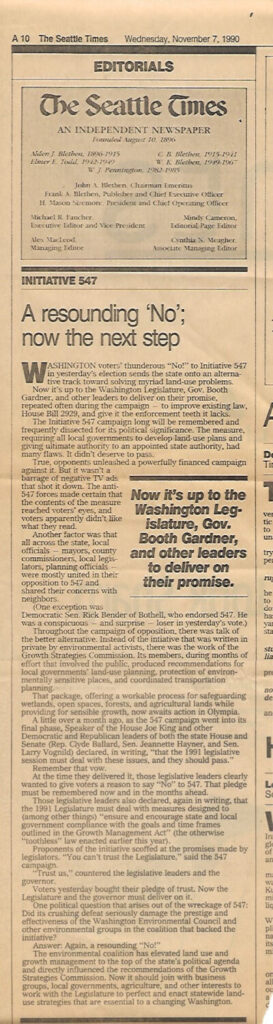
In the end, and especially after the four-corners letter, many advocates and organizations came out in support of working with the existing GMA bill, and voted down I-547’s alternative.
But everyone involved promised to pick up the work on growth management in the next legislative session; I-547 had successfully channeled the public’s energy around land use, rapid development, and environmental concerns, and advocates and legislators alike noted that the initiative had helped sustain public pressure on the legislature.
June 28, 1991 – Legislative Session
Promises Kept: GMA Phase II Passes the Legislature
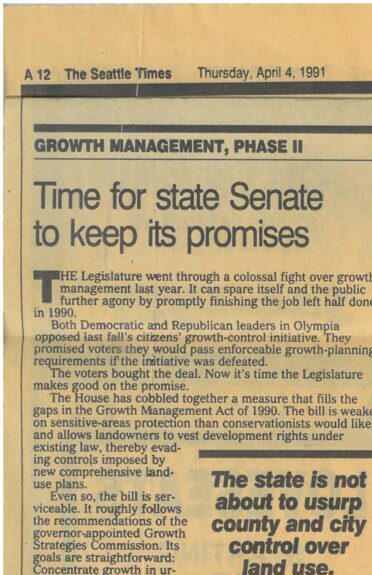
The promise of the Four Corners letter was front and center in the 1991 legislative session, and elected leaders introduced ESHB 1025 (GMA Phase II). This bill incorporated advocates’ feedback and the Growth Strategies Commission’s recommendations, including the key concept of concurrency, and established hearing boards that could mitigate disputes about compliance.
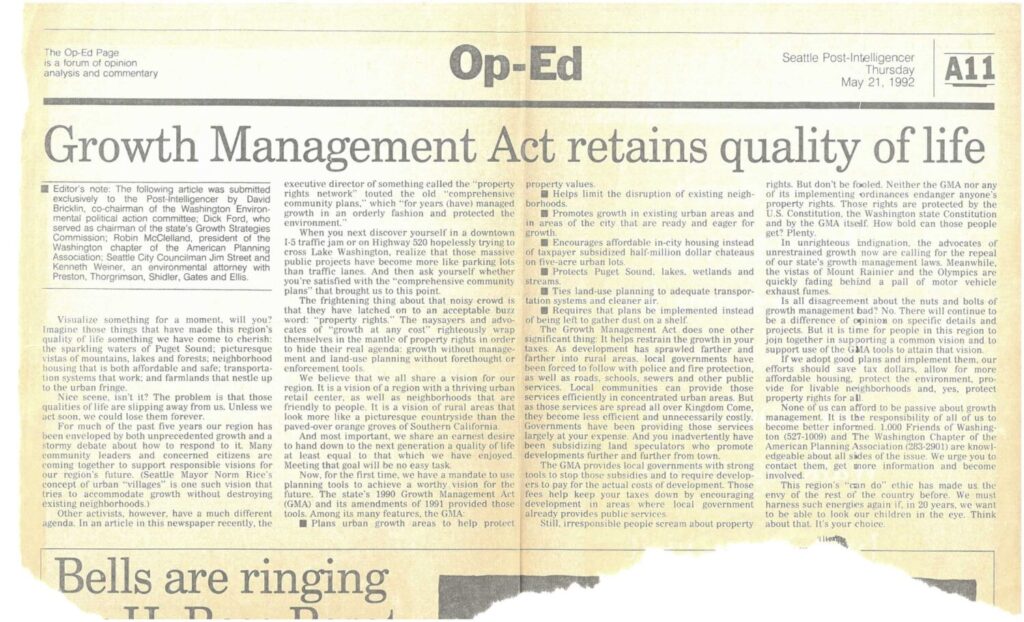
When asked why he believed the effort behind the GMA was so effective, Mike McCormick, the first Director of Growth Management, reflected:
“Everybody that had a different piece of the GMA wanted to make it work. The planners wanted to see it succeed, elected officials wanted this to be successful, and by and large, it wasn’t done reluctantly at the local level.”
On our 30th Anniversary, we spoke with a number of founding board members and partners that have been involved since the beginning.
This timeline is part of a dynamic, living history, and only the first launch of an ongoing project. We know there’s no way to encapsulate the full involvement of all the incredible individuals who played a role in the creation and implementation of the GMA. We will have opportunities for more people to contribute and share their stories. Please stay tuned.