The Board Has Ruled: Aspirational Is Not Enough
By Brooke Frickleton, Deputy Legal Director & Staff Attorney
Back in June, we told you about Futurewise’s challenge to Thurston County’s newly adopted climate element — the first real test of the climate planning requirements the Legislature added to the Growth Management Act through HB 1181.
On August 17, the Growth Management Hearings Board ruled that Thurston County’s plan does not comply with the GMA: both the greenhouse gas emissions reduction subelement and the climate resiliency subelement failed.
This decision matters well beyond Thurston County. It provides guidance on what compliance with HB 1181 looks like: climate planning that is built to work, not just sound right.
A quick recap
Thurston County adopted its ten-year periodic comprehensive plan update in December 2025, including a new required climate element.
Futurewise challenged this update on three issues:
- That the greenhouse gas emissions reduction subelement lacked the measurable policies needed to hit the County’s own adopted target.
- That the climate resiliency subelement responded to serious, documented hazards with commitments to “study,” “encourage,” and “seek” rather than policies that actually address them.
- That the County’s updated development regulations failed to meet state requirements concerning permit-exempt wells.
The Board’s Final Decision and Order addressed each in turn.
Greenhouse gas reductions: the County had a roadmap and didn’t use it
The GMA requires jurisdictions to identify actions that will reduce greenhouse gas emissions from land use and transportation, consistent with the Department of Commerce’s climate element guidance. In its updated comprehensive plan, the County adopted a target of 95 percent emissions reduction by 2050 — but did not include the measurable policies needed to reach it.
Under HB 1181, Commerce was directed to publish statewide guidance identifying measures counties and cities can use to reduce greenhouse gas emissions, based on the state’s official reporting.
Thurston County argued that this guidance is advisory rather than binding: that jurisdictions retain discretion to select their own goals and policies, and that the guidance was never subject to formal rulemaking.
The Board disagreed.
Commerce’s Thurston County 2022 Greenhouse Gas Emissions Analysis inventories the County’s emissions, models future scenarios against the state’s reduction targets, and lays out specific strategies for reducing emissions in Thurston County.
Land use was one example. The analysis identified changes in land use, transportation infrastructure, and commuting options as key opportunities to reduce emissions from passenger vehicle travel. This is exactly the kind of concrete strategy the County’s plan left unaddressed.
That gap mattered legally because as the Board explained the Legislature directly required jurisdictions to be consistent with Commerce’s guidance — or, alternatively, to demonstrate equivalent results based on “scientifically credible projections and scenarios.” The County could not treat that guidance as optional.
Thurston had access to a locally tailored set of measures, funded and developed by Commerce specifically to help the County meet this requirement, and adopted neither those measures nor an independently justified alternative. On that basis, the Board found the greenhouse gas subelement noncompliant.
Climate resiliency: the subelement fell short on implementation, specificity, and equity
The climate resiliency subelement is one of the newest, least-tested pieces of climate planning requirements, and this decision is among the first to substantively examine it.
The County’s own records show the climate risks it’s currently facing:
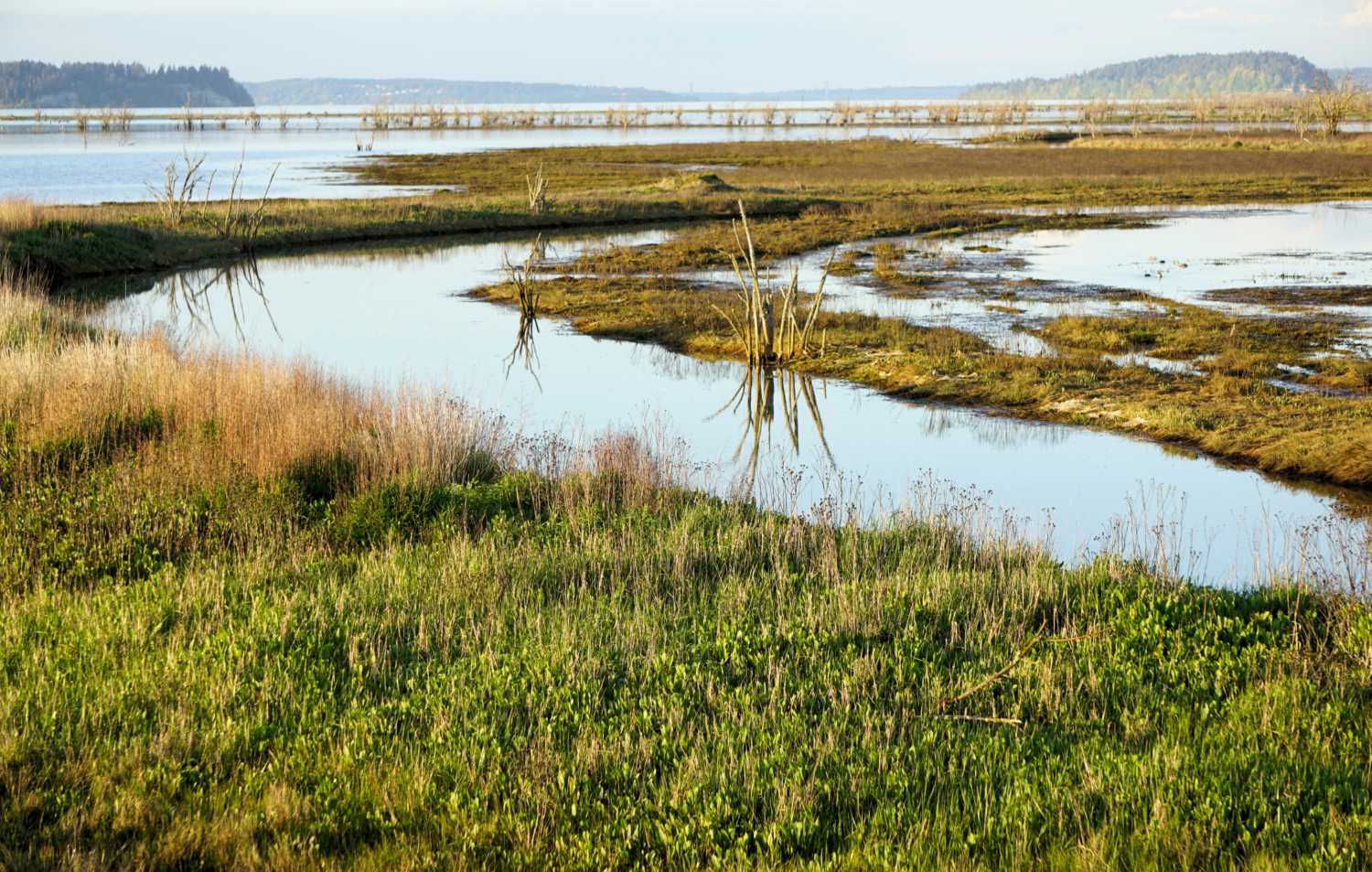
- The entire Puget Sound shoreline of unincorporated Thurston County lies within the sea level rise inundation zone.
- The Billy Frank Jr. Nisqually National Wildlife Refuge faces inundation with nowhere inland for habitats to migrate.
- 18,500 structures already sit in the wildland-urban interface and are at risk from frequent wildfires.
Yet Thurston County responded to those documented hazards with commitments to “study,” “encourage,” and “seek” — not policies that addressed them. And the statute’s own word is “address.”
The Board identified three separate problems with the County’s approach.
First, the County needed a way to put its policies into practice. While the County adopted resiliency policies, it adopted no development regulations to implement. The Board held that comprehensive plan policies must be carried out through specific regulatory mechanisms or programs, not left to stand alone.
Second, the County needed to commit to specific action. Much of the resiliency subelement simply restated the language of the statute without committing the County to any specific, action-forcing step. The Board was clear that aspirational language isn’t automatically wrong, but a subelement built entirely out of aspirations — with no programs, deadlines, or funding commitments behind them — does not meet the minimum standard.
Third, the County needed to meaningfully account for the communities most affected. Jurisdictions are required to prioritize actions that benefit overburdened communities. The Board held that this requires identifying those communities and showing real collaboration with them, not a general reference to equity as one factor among others.
These aspiration-versus-direction distinctions echo our Mercer Island case from last year. The Board’s message across both cases is consistent: good intentions alone on paper are not enough. Jurisdictions need to back them with credible, measurable plans.
A closer look: the overburdened communities requirement
The “overburdened communities” requirement deserves particular attention because it is the part of the statute most likely to be reduced to general equity language if jurisdictions are not held accountable to it.
Under RCW 36.70A.070(9)(e)(i), cities and counties must prioritize actions that benefit overburdened communities that are disproportionately vulnerable to climate-driven natural hazards and face overlapping environmental threats. Commerce’s climate element guidance calls for jurisdictions to identify those communities and collaborate with them to determine whether proposed measures are equitable and avoid disparate impacts.
Thurston County pointed to several adopted policies – including provisions requiring environmental justice audits before rezones, weatherization assistance directed to overburdened communities, and community-owned renewable energy projects – as evidence that it had met this requirement.
The Board acknowledged that some of these policies included real action steps but found that none of them named the overburdened communities they were meant to serve. And the County did not show that it had collaborated with those communities to identify their needs or shape its response.
Many climate elements moving through adoption across the state use similar general, well-intentioned equity language: references to “vulnerable populations” or “environmental justice” without identifying who those communities are locally or showing that they helped shape planning.
This decision establishes that identifying affected communities and showing collaboration with them is part of the statutory minimum — not an optional addition.
Where the groundwater claim landed
The Board agreed with Futurewise that the County had not implemented state water availability requirements in county code, rejecting the County’s argument that its sanitary code was sufficient.
But the Board concluded it lacked authority to hear the claim at all. Because RCW 36.70A.590 took effect in 2018, before the County’s 2019 periodic update, Futurewise needed to raise this issue in that earlier update cycle.
As a result, the Board dismissed the groundwater claim as untimely. We’re reviewing that ruling and considering next steps.
What’s next
The Board sent the climate element back to Thurston County, with compliance due by February 16, 2027 and a compliance hearing set for April 6, 2027. The County must now revise its climate planning to include specific goals that are backed by policies, programs, and regulations that can meaningfully reduce emissions and advance community resilience. The Board’s decision could also be appealed to court.
In a separate but related piece of the same case, the Board also struck down the County’s Black Lake Quarry rezone as internally inconsistent with the comprehensive plan and invalid under the GMA. This is a win for South Sound Bird Alliance and the other petitioners in that consolidated appeal.
Why this matters beyond Thurston County
The Legislature made it clear when it passed HB 1181: climate planning is not optional.
The Board’s decision reinforced that aspirational language does not satisfy that requirement This decision also confirms that the Commerce’s guidance carries real legal weight.
Climate elements are new terrain for jurisdictions across the state, and this decision is the clearest guidance yet on what compliance looks like. For counties currently finishing their periodic updates and for the ones that are still working through hearings and comment periods, we’ll be putting this decision to use across our work in the months ahead.
If your community is working through its own climate element right now, this is a good moment to ask: does it just say the right things, or is it built to actually do them?
Futurewise’s Legal Program is funded by supporters like you. If you’d like to support this work, donate here or reach out to learn more about getting involved.