Spokane County’s Growth Pattern and the August 2026 Wildfires
By Brooke Frickleton, Deputy Legal Director & Staff Attorney
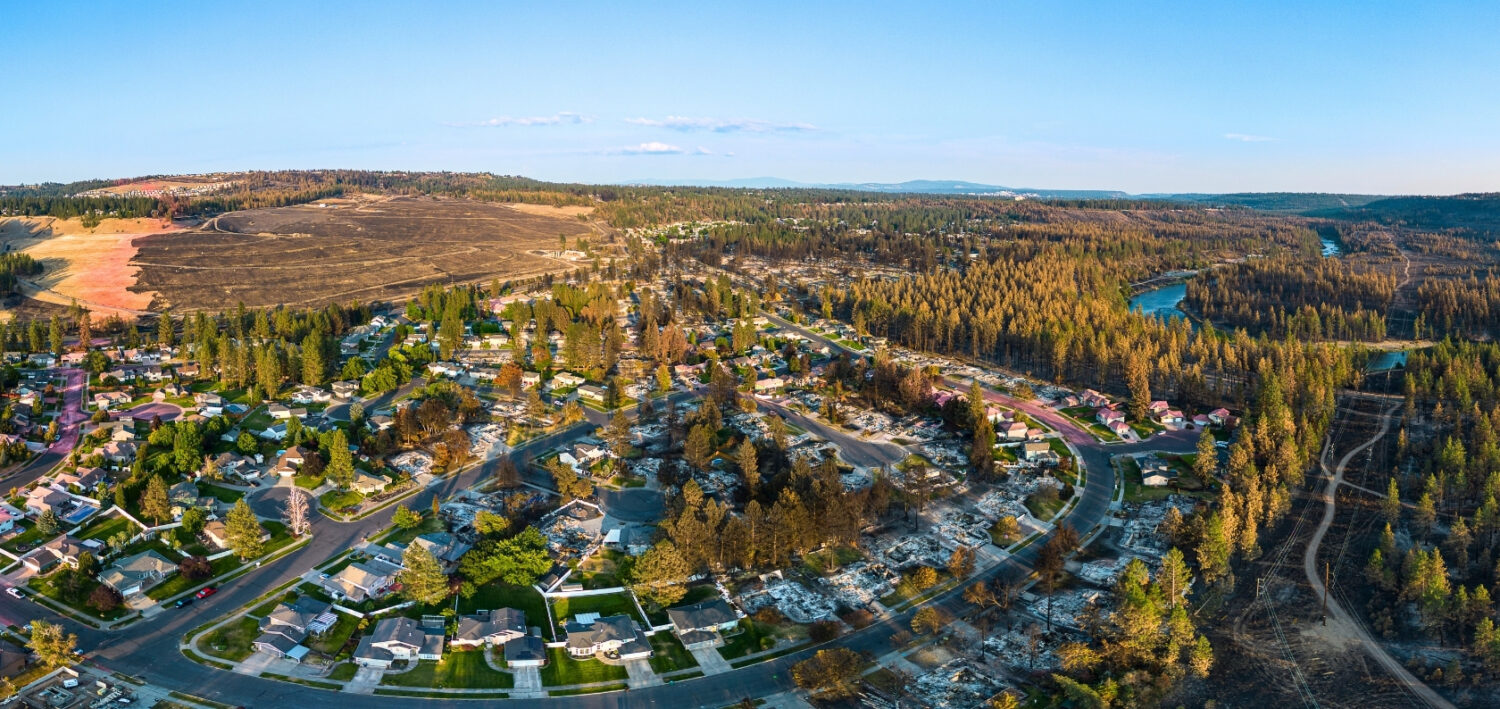
In the first week of August 2026, three wildfires — Old Trails, Fairview, and Autumn Lane — tore through the peripheral of the City of Spokane and unincorporated Spokane County, burning more than 11,000 acres, destroying or damaging an estimated 850 to 1,000-plus structures, and forcing nearly 67,000 people to evacuate. The Old Trails Fire alone ignited near Airway Heights, jumped the Spokane River within hours, and swept into Indian Trail and Five Mile Prairie, burning more than 3,600 acres and damaging or destroying 694 structures. Amid the destruction, the community’s response has been genuinely inspiring: public schools opened day camps for displaced families, and neighbors organized food and boot drives for the wildland firefighters working around the clock on the fire lines.
This is now the most destructive wildfire event in the county’s history, devastating communities across Spokane’s wildland–urban-interface (WUI), including areas where Futurewise has spent more than a decade challenging the expansion of low-density development into rural, wildfire-prone land. As communities recover, planning for what comes next matters: future growth decisions should avoid increasing exposure where wildfire risk, evacuation constraints, and fire-service needs are already evident.
Futurewise has a longstanding record of challenging both site-specific development and outward UGA growth in the Five-Mile Prairie area and the broader Spokane region. In the early 2010s, Futurewise and the Five-Mile Prairie Neighborhood Association challenged a County-approved plan amendment and rezone for a 22.3-acre site, part of the broader wildland–urban-interface landscape. The Growth Management Hearings Board found that the proposal lacked adequate access and public-facilities support, and the Washington Court of Appeals restored that decision in 2015, leaving the amendment invalidated.
Futurewise returned to the Growth Management Hearings Board and then the courts over Spokane County’s 2020 Comprehensive Plan, challenging its deficient capital-facilities element. In 2022, the Washington Court of Appeals held that the County had to inventory and plan for publicly owned capital facilities across its entire planning area, not only within urban growth areas.
Spokane County has made meaningful progress in addressing deficiencies identified in these earlier cases, including through updates to its capital-facilities planning and in the current periodic-update process, recently responding to feedback from the community and Futurewise by shifting a substantial share of proposed rural housing allocation to urban areas. Futurewise recognizes that progress and encourages the County to build on it in the 2046 update by ensuring that land-use, capital-facilities, and climate-resiliency policies work together to limit additional exposure in high-risk WUI areas.
While these cases were not wildfire litigation, they reflect a broader, continuing concern about expanding low-density development into rural and undeveloped areas without fully accounting for the public facilities, infrastructure, and long-term risks that growth in these areas requires.
By 2025, wildfires had become explicit in Futurewise’s case. Comments on the county’s 2046 Comprehensive Plan update warned that large areas of unincorporated Spokane County sit in the wildland-urban interface, that wildfire risk is worsening, and that mitigation should include directing growth away from the WUI. This regional challenge calls for coordinated action by Spokane County, the City of Spokane, fire districts, utilities, and neighboring communities.
The county’s Climate Vulnerability Assessment demonstrates that Spokane County ranks higher than 82 percent of U.S. counties in wildfire risk and that residential development is expanding into high fire-risk areas, citing the 2023 Gray Fire and Oregon Road Fire, which had already burned 20,000 acres and destroyed more than 300 homes. That data has not yet been translated into binding policy. Futurewise is preparing to submit comments on the County’s draft Climate Element, including concerns that its wildfire policies only direct the County to “promote” fire-resistant materials and “identify strategies” for reducing WUI development pressure. This aspirational language that does not restrict new construction in high-hazard areas, adopt a WUI code, or bind the county’s own Community Wildfire Protection Plan into enforceable development regulations.
Citing the Growth Management Hearings Board’s August 2026 ruling in South Sound Bird Alliance v. Thurston County, which held that “vague general policies without clear, action-forcing implementation measures” fail the Growth Management Act’s resiliency mandate, Futurewise’s advocacy will urge the County to consider code revisions, including a WUI code that prohibits new residential development in high- and extreme-hazard areas, mandatory defensible-space standards, and undergrounding requirements for new power lines in high-risk zones — a direct response to Avista’s recurring shutoffs in wind-and-slope-prone Indian Trail.
Spokane County’s 2026 Hazard Mitigation Plan, released just a few months before the fires, is a genuine step forward. But a hazard mitigation plan identifies risk and funds preparedness; it does not stop new subdivisions from being approved in the highest-hazard parcels it maps. Closing that gap is exactly what Futurewise’s advocacy on comprehensive plans and specifically climate elements is pressing for.
With the 2046 Comprehensive Plan periodic update process still ongoing, Spokane County has an opportunity — alongside the City of Spokane, fire districts, utilities, and neighboring jurisdictions — to apply the lessons of past growth-management decisions to the region’s future growth pattern. Spokane County should prioritize infill and compact development in already serviced areas, while applying strong, enforceable resilience standards wherever new development occurs near wildfire-prone lands. The recent fires underscore why coordinated regional planning should reduce—not increase—the exposure of homes, infrastructure, public services, and emergency responders where communities meet wildfire-prone lands.
Author’s note: Brooke Frickleton, Futurewise’s Deputy Legal Director, lives in the City of Spokane. While she was not personally displaced by the August wildfires, the fires affected people in her community, including friends and acquaintances who were evacuated or lost their homes.
Editor’s Note, September 2, 2026: This article has been updated for greater legal and geographic precision: to distinguish the separate legal cases, clarify that the wildfires affected communities across the Spokane region, and more accurately describe Spokane County’s subsequent work on GMA compliance. The article’s central point remains unchanged: the recent fires highlight the need to learn from past growth decisions and ensure that future regional land-use planning reduces — not increases — exposure where homes, infrastructure, and public services meet wildfire-prone lands.